Start here
Ceresian State System
Junic legitimacy, imperial continuity, Gischenism, public finance, and the archive's central state tradition.
A public, published-only guide to the setting. Use the historical reading paths first; futuristic starworks material sits at the bottom after the political and dynastic foundation.
Curated entry points for the main political, religious, military, dynastic, and technological arcs.
Junic legitimacy, imperial continuity, Gischenism, public finance, and the archive's central state tradition.
The Rietan colonial order, Papersmith organization, the independence war, and the postwar Perlian settlement.
Roscovia, Rietan, Manhisan, Frenemica, the Great War, and the diplomatic order after continental exhaustion.
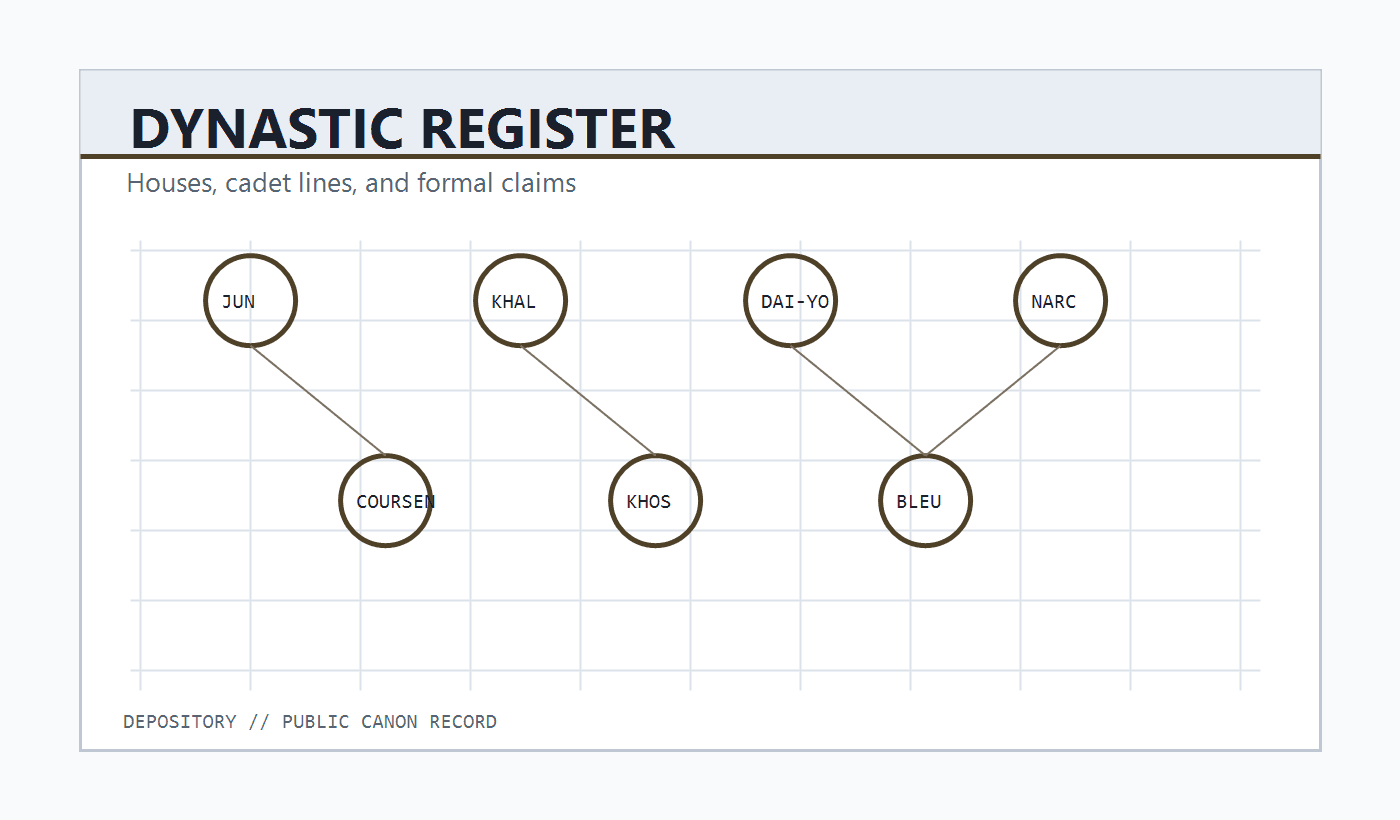
Noble houses, Proto-Ceresian roots, Daiyo restoration, Ran collapse, and Khosagar continental order.
KIC, Nieuwerk, wormhole systems, strategic resources, and interstellar industry after the historical foundation is clear.
AT-E-X is Nieuwerk's advanced energy-conversion family, developed to outperform legacy AT-E systems and reduce strategic pressure from Element 0 scarcity.
Continental independence coalition that coordinated anti-Rietan revolutionary, royalist, republican, tribal, guild, and foreign-backed forces during the Ceresian War of Liberation.
Astaran is the southern Ponitzian capital city central to Sannamid, Hanmavian, Manhisan, and treaty history.
The Astaran League was the anti-Roscovian coalition of Manhisan, Frenem, Rietan, and allied southern powers formed before the Great War.
The Capital Regime was the Rietan extractive corporate order that converted colonial Ceresia and Perlia into privileged commercial zones for Rietanian companies.
The Ceresian Imperial Republic is the post-liberation Ceresian state, combining imperial continuity with Gischen technocratic republican institutions and later interstellar hegemony.
The Ceresian Labor Authority is a government corporation administering the labor draft, post-automation employment assignments, and interstellar colonial labor flows.
Ceresian Model Economics is the global term for economies reorganized around dependence on cheap Ceresian resources and goods, despite not being the model Ceresia uses internally.
The Ceresian Tesamaic was the imperial Ceresian order that grew from Junic Ceresia, Kalarian conquest, and the Tesamaic title of harmonized rule.
100 published records
AT-E-X is Nieuwerk's advanced energy-conversion family, developed to outperform legacy AT-E systems and reduce strategic pressure from Element 0 scarcity.
Continental independence coalition that coordinated anti-Rietan revolutionary, royalist, republican, tribal, guild, and foreign-backed forces during the Ceresian War of Liberation.
Astaran is the southern Ponitzian capital city central to Sannamid, Hanmavian, Manhisan, and treaty history.
The Astaran League was the anti-Roscovian coalition of Manhisan, Frenem, Rietan, and allied southern powers formed before the Great War.
BC Frau Lumber Corporation was the Frenemican company whose Ceresian timber concession became the incubator of Papersmith organization.
Coalition victory during Phase I of the Ceresian War of Liberation. Divided colonial holdings through control of the Topnah Valley.
The Capital Regime was the Rietan extractive corporate order that converted colonial Ceresia and Perlia into privileged commercial zones for Rietanian companies.
Ceresian Armaments refers to the modern Ceresian weapons ecosystem, including Ezad Industries, Ceresian Armaments Consolidated, and standard firearm platforms.
The Ceresian Imperial Republic is the post-liberation Ceresian state, combining imperial continuity with Gischen technocratic republican institutions and later interstellar hegemony.
The Ceresian Labor Authority is a government corporation administering the labor draft, post-automation employment assignments, and interstellar colonial labor flows.
Ceresian Model Economics is the global term for economies reorganized around dependence on cheap Ceresian resources and goods, despite not being the model Ceresia uses internally.
The Ceresian Tesamaic was the imperial Ceresian order that grew from Junic Ceresia, Kalarian conquest, and the Tesamaic title of harmonized rule.
Armed conflict that transformed decades of Papersmith asymmetrical warfare into a formal independence movement across the Perlian continent, ending global Rietan military, economic, and naval hegemony.
Colonial Ceresia was the Rietan Triumviral Colonial Government and Capital Government imposed after the conquest of the Ceresian Empire.
Crastinist Unitarianism was the prophetic-humanist ideology that justified Hanmavian conquest as temporary universal unification.
The Daiyo Empire was the restored Hyun imperial order founded by the Dai-Yo house after revolt against Ran subjugation and later drawn into Ceresian and Rietan imperial history.
Successor state to the Heavenly Daiyo Empire after coalition independence and restoration politics.
The Dansk Faction was the Rietanian conspiratorial faction that assassinated King Jonathan Narcissus XVI but failed to kill Prince Edward.
The Diyoning Root Civilization was the ancient civilization of the Diyoning peninsula and northern Hyuna River valley, remembered as the pre-Ran foundation of Hyun civilization.
Element 0 is a scarce strategic resource used in AT-E and wormhole technologies, motivating Nieuwerk's efficiency programs.
Element Z is the exotic material whose extraction made Ceresian wormhole generation, asteroid recovery, and later interstellar industry commercially and strategically viable.
The Era of Trouble was a continental crisis in Rosoviya and the Northern League marked by revolutions, dynastic collapse, and the rise of Volkygodian socialism.
The Federation of States was a central Ponitzian buffer state that became a powerful mixed-warfare actor and rival to both Rietan-Frenem and Volkygodian interests.
Colonial victory during Phase I of the Ceresian War of Liberation. Alkali-infused grease weapons burned the Royal Sequoia grounds and terrorized unarmed coalition members.
Civil war that followed the end of the Supreme Admiralty after the Ceresian War of Liberation.
The Frenemican Republic was a major post-Hanmavian Ponitzian state, industrial power, Anti-Rietan supporter, and later arena for far-right mobilization.
The Frenkian noble houses formed the dynastic architecture of the Frenkian Pact, including Rugen-Frenkia, Bleuberg-Frenkia, Nassae, Hottorp, Meinstall, Burdorf, Astoria, and Coduremberg.
Georgi Raznapatov was the Marshall-Premier of Roscovia whose intelligence background, asymmetric experience, and Ceresian-licensed technology drove Roscovian military success.
The Hanmavian Empire was the largest empire of the 100s, founded from Crastinist unitarian revolution in Astaran and later collapsed into the Manhisan state.
Hanzo Gische was the Papersmith revolutionary leader, first premier, and principal architect of Ceresia's technocratic post-liberation order.
Harsmouth was the northern Rietanian region whose socialist breakaway helped trigger the Great War.
The House of Bleuberg was a Frenkian imperial dynasty later tied to Frenemica, Rietan Ceresia, and Ceresian regencies.
The House of Crastin was the prophetic and dynastic foundation behind Astaran-Hanmavian unitarian imperialism.
The House of Daiyo emerged from Dai and Yo consolidation and became the imperial dynasty of restored Hyuna.
The House of Junio-Coursen rules Egden and traces its divine compact to Jun through the Coursen queen's miraculous birth tradition.
The House of Junio-Kahlian is the imperial Ceresian dynasty tracing political rule to Jun and the Kahlian tribal confederacy.
The House of Khosagar-Kahlain is the Ceresian-linked continuation of the Khosagar line after regency, conversion, republicanization, and restoration of ancestral influence.
The House of Narcouster unified Lonardian kingdoms into the Narcouster Empire and later became the figurehead monarchy of Rietan.
The House of Ran was the hereditary sacred ruling house of the Ran apocalyptic empire.
The House of Terarosa was the ruling house of Teranos, the strongest Ceresian princely duchy before Rietan destruction of the city.
The House of Voyar unified much of Rosoviya through personal unions before being overthrown by Volkygodian socialism.
Rietan colonization transformed Ceresian government, language, culture, and economy through extractive corporate rule and cultural suppression.
The Imperial Fund is the Ceresian sovereign fund and investment institution that coordinates state finance, strategic companies, and technocratic development.
Successor state to the Ceresian Tesamaic established after the Ceresian War of Liberation.
The Inarim People’s Democratic Republic was the southern Ponitzian revolutionary government dissolved under the Treaty of Ceresia.
The Inarim Republican Army was a violent third force during the Great War whose crimes led to dissolution and trials under the Treaty of Ceresia.
Postwar instruments that managed foreign economic exit, honorable retreat for foreign combatants, immigrant policy, formal diplomacy, debt repayment, and recruitment of foreign scientists.
Jonathan Thumbria was the nationalist veteran and Action Development Party leader whose name defined the Thumbrian Party and Thumbrianism.
Jun is the divine emissary and central deity of Juni'ism, whose dynastic and religious lines shaped Ceresian and Egdenite legitimacy.
Juni'ism is the Junic form of Ceresian polytheism centered on Jun as liberator deity and divine emissary, functionally monotheistic while formally acknowledging multiple deities.
The Kalarian Campaigns were the wars of conquest, regency, and influence fought by Kalarian I and II that transformed Ceresia from city-state into continental superpower.
The Karanshae Federation was the eunuchial and slave-warrior regime whose misrule preceded the Crastinist revolution and Hanmavian Empire.
The Kessetian Tribal Confederation was the migrating southern people whose fractured kingdoms formed the prehistory of Astaran and the Sannamid order.
The Khosagar Khaganate was a major western Perlian steppe and maritime empire whose alliance and rivalry with Ceresia shaped continental politics.
The Khosan Republic was the republican successor to the Khosagar Khaganate, founded after the Khosan Revolution and later integrated into the Ceresian-led order.
Coalition victory during Phase I of the Ceresian War of Liberation. Split the colonial supply network into four separate theaters along the western Ceresian border.
King Jonathan Narcissus XVI was the post-Great-War Rietanian monarch who granted emergency powers to reconsolidate the country before his assassination.
Direct military ally of the coalition whose status was re-formalized as a continued autonomous union after the war.
Kohlian Enterprises Inc. is the public holding company through which civilian investors access part of the Kohlian Industries Consolidated system.
Ceresian industrial federation and space-industrial engine
Kohlian Industries Consolidated is a Ceresian industrial federation jointly operated through Kohlian Enterprises Inc., federation members, and the Imperial Fund, serving as the central engine of Ceresian space industry.
The Lonardian noble houses were mostly absorbed into the House of Narcouster, leaving Lantorian and associated lines as notable exceptions.
The Manhisan Empire was the successor core of the Hanmavian collapse and later a major participant in Anti-Rietan and Great War diplomacy.
The Marshanavid Empire was the successor to the Sannamid order, known for preserving river boundaries and maintaining a professional slave-soldier army.
Moel1 is Nieuwerk's compact wormhole-generator prototype, notable for producing small wormholes with sharply reduced Element 0 requirements.
MoelK is the KIC-Nieuwerk Moel-class variant developed to retrofit or replace systems on KIC flagship wormhole generators.
The Narcissean Restoration was the Rietan Civil War phase in which royal armies reconsolidated Rietania under Prince Edward and King Jonathan.
The Narcouster Empire unified Lordshire, Pomdries, Narcissus, Hottorp, and frontier possessions before its defeat by the Hanmavian Revolution and later transformation into Rietan.
The National Technocratic Front is the Ceresian political party founded by Hanzo Gische and dominant since the post-liberation constitutional order.
Ceresian-registered starworks company
Nieuwerk F.G. is a Ceresian-registered starworks startup founded by Frenemican scientists and engineers specializing in compact wormhole generation and high-efficiency AT-E energy conversion.
Colonial victory during Phase I of the Ceresian War of Liberation. A large expeditionary force was annihilated by river gunships and Rietan mortaring.
The Northern League was the Voyar-led personal union of major Rosoviyan kingdoms, sharing currency, infrastructure, open borders, and a standardized noble military.
Pan-Rosoviyan Art Baroque was the monumental civic style used by the National Renovation to make public space express Roscovian unity and supremacy.
Revolutionary coalition directed by Hanzo Gische that linked the Papersmith councils of Ceresia, Sagaria, the South, Hyun, and Egden into a continental logistics and military network.
The Papersmith Movement was the revolutionary network that grew from paper smuggling, illegal publications, and armed cells in colonial Ceresia.
Parthoguer Frenkie, commonly PGF, was a far-right Frenemican political party rooted in Great War veteran radicalization and the Parthoarmie paramilitary system.
The Pensama is the supreme interpretive religious office of Juni'ism, chosen from the Divine Junic Dynasty by monastic selection.
The Ponitzian Imperium is a theorized ancient continental order invoked by Hanmavian ideology as precedent for unifying Ponitz.
Prince Edward Narcissus XLII was the Rietanian crown prince, Royal Army commander, and later king whose reforms shaped the post-civil-war state.
Project Dreammaker was KIC's moon-scale wormhole-generator program, redirecting most of Ceresian advanced industry toward the first successful interstellar generator vessel.
The Proto-Ceresian Civilization was an ancient city-state system centered on Ceres at the Central Perlian River confluence and remembered as the root of later Ceresian language, religion, and kingship.
Colonial victory during Phase I of the Ceresian War of Liberation. Devastating losses forced Hanzo Gische to shift strategy directly.
The Ran Empire was a militaristic apocalyptic theocracy from the Ranien mountains whose sacrificial ideology devastated Hyuna and shaped the rise of Ceresia and Daiyo.
The Ran-Daiyo conflicts were the succession of rebellions, liberation wars, and exterminatory campaigns through which the Daiyo state replaced Ran authority in Hyuna.
State formed through consolidation of the Spice League Confederation into Spiasathinum, also known as Spiasa.
Revised Noble Houses is the consolidated dynastic register for the major Frenkian, Lonardian, southern, Ceresian, Khosagar, eastern, Spiksan, and Ran noble lines.
The Rietan Civil War was the post-Great War struggle in which royal forces reconsolidated Rietania after territorial loss, warlord fragmentation, and rebellion.
Postwar crisis triggered by the collapse of Rietan hegemony, the end of the Supreme Admiralty, and the beginning of the First Rietan Civil War.
The Rietan Imperial Republic is a maritime trade empire on the Leonard Peninsula, successor to the Narcouster Empire and former hegemon over continental Perlia.
The military-admiralty regime that dominated Rietan imperial policy and collapsed after the liberation of Ceres and the Treaty of Astaran.
The Rietanian Socialist Republic was a Roscovian-aligned socialist force in northern Rietania during the Great War crisis.
The Roscovian Communist Republic succeeded the Volkygodian socialist order after civil debate, nationalist renovation, and the consolidation of Rosoviyan communist-fascist party structures.
The Rose League was the post-Hanmavian bloc of local nobles and splinter states that broke from the empire and divided much of Ponitz.
Rosoviya is the northern Ponitzian super-region whose peoples, languages, dynasties, and nationalist memory formed the basis of Volynia, the Northern League, and Roscovia.
The Rosoviyan National Renovation was the total aesthetic and infrastructural program that transformed Roscovian nationalism into mass political culture.
The Royal Sequoia Woodlands were the massive Ceresian forest holdings where BC Frau workers and paper access helped form the Papersmith Movement.
The Sannamid Empire was the Astaran successor order that restored southern control after Kessetian fragmentation and prefigured the Hanmavian imperial region.
Coalition victory during Phase I of the Ceresian War of Liberation. Captured an important western Ceresian city and strengthened Khosagar tribal courting.
Coalition victory during Phase I of the Ceresian War of Liberation. Ended Rietan rule in easternmost Ceresia while central colonial power remained strong.
Colonial victory during Phase I of the Ceresian War of Liberation. Failed after the North Pearl River Campaign prevented reinforcements from arriving.
Coalition victory during Phase I of the Ceresian War of Liberation. Secured control over an important aquifer tributary of the Pearl Rivers.